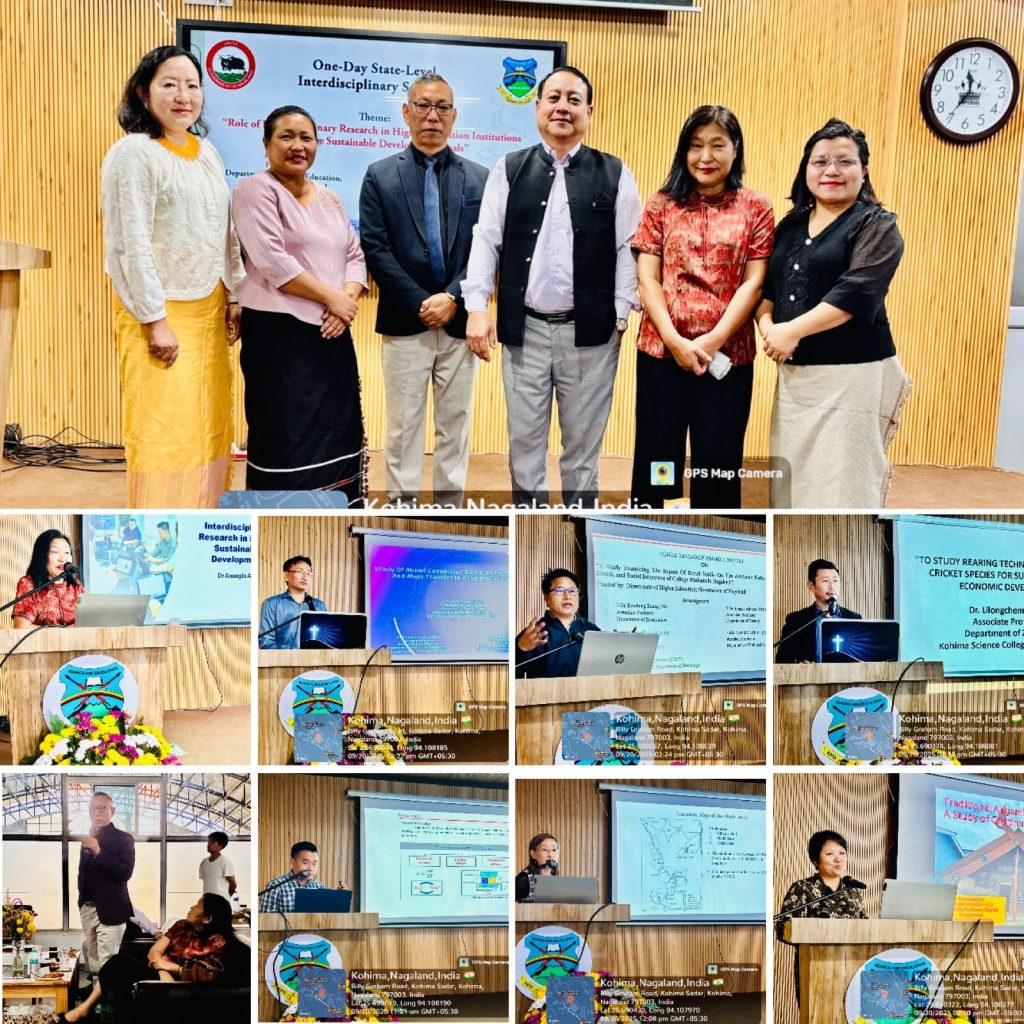
Kohima College on Saturday hosted a one-day state-level seminar on the theme “Role of Interdisciplinary Research in Higher Education Institutions to Achieve Sustainable Development Goals.” Funded by the Department of Higher Education, Government of Nagaland, and organised by the college’s IQAC and Research & Development Cell, the event brought together faculty, researchers and students from Kohima Science College, St. Joseph’s College (Jakama), and several other institutions across the State.
The programme opened with welcoming remarks from Chairperson Dr. Eunice Alinger (Associate Professor, History, RDC, KCK), and invocation by Ms. T. Shancholo Khuvung . Dr. Alinger thanked the Department of Higher Education for its support and described the seminar as the culmination of a major initiative to promote faculty development through research funding. Tokens of appreciation were presented to distinguished guests, including Dr. K. Nishena Nekha (Additional Director, Higher Education), keynote speaker Dr. I. Anungla Aier (Former Director, Higher Education), and Principal Dr. Vitsosie Vupru.
In his welcome address, Principal Dr. Vitsosie Vupru framed research as central to institutional growth and urged presenters to translate their projects into publications and policy-relevant outputs. He thanked the Department of Higher Education for providing the platform and financial support that enabled the seminar.
Dr. K. Nishena Nekha outlined the grant rationale, emphasising the transformative potential of faculty research and the Department’s aim to widen research participation. Acknowledging practical hurdles such as funding and competing duties, Dr. Nekha argued that research is accessible and essential: “Everybody can do something,” he said, calling for interdisciplinary teams to address complex state challenges like rural–urban migration, biodiversity management and climate adaptation.
Keynote speaker Dr. I. Anungla Aier delivered a wide-ranging address that positioned interdisciplinary research as necessary – not optional -for tackling multifaceted development problems. Drawing on her experience in multi-disciplinary projects, Dr. Aier stressed problem-focus, integration of knowledge, and the need to translate research into implementable policies. She highlighted priority areas for Nagaland, including urban planning, disaster resilience, ageing populations, and curriculum development that integrates traditional knowledge.
Technical Session I (chair: Dr. Medongunuo Ngone) featured applied science and modelling papers on thermoelectric materials, electrical resistivity surveys for Kohima town, mixed convection flow studies, and hydrologic basin modelling for Kohima district — all with local planning implications.
Technical Session II (chair: Dr. Prescilla Ezong) showcased work on museum digitisation, cricket rearing for livelihoods, sequencing of chickpea-nodulating rhizobia, studies of traditional Angami architecture, and social research on social media’s effects on student wellbeing and performance.
Closing remarks by Dr. Kekhrieseno Christina (HoD, Sociology & Director, RDC) reiterated the need to institutionalise interdisciplinary collaboration. Certificates were distributed and the seminar ended with a communal lunch.
The event underscored a growing research culture in Nagaland’s higher education sector: with targeted funding and cross-disciplinary collaboration, institutions are positioning themselves to produce locally relevant, actionable research that can inform state policy and sustainable development initiatives.