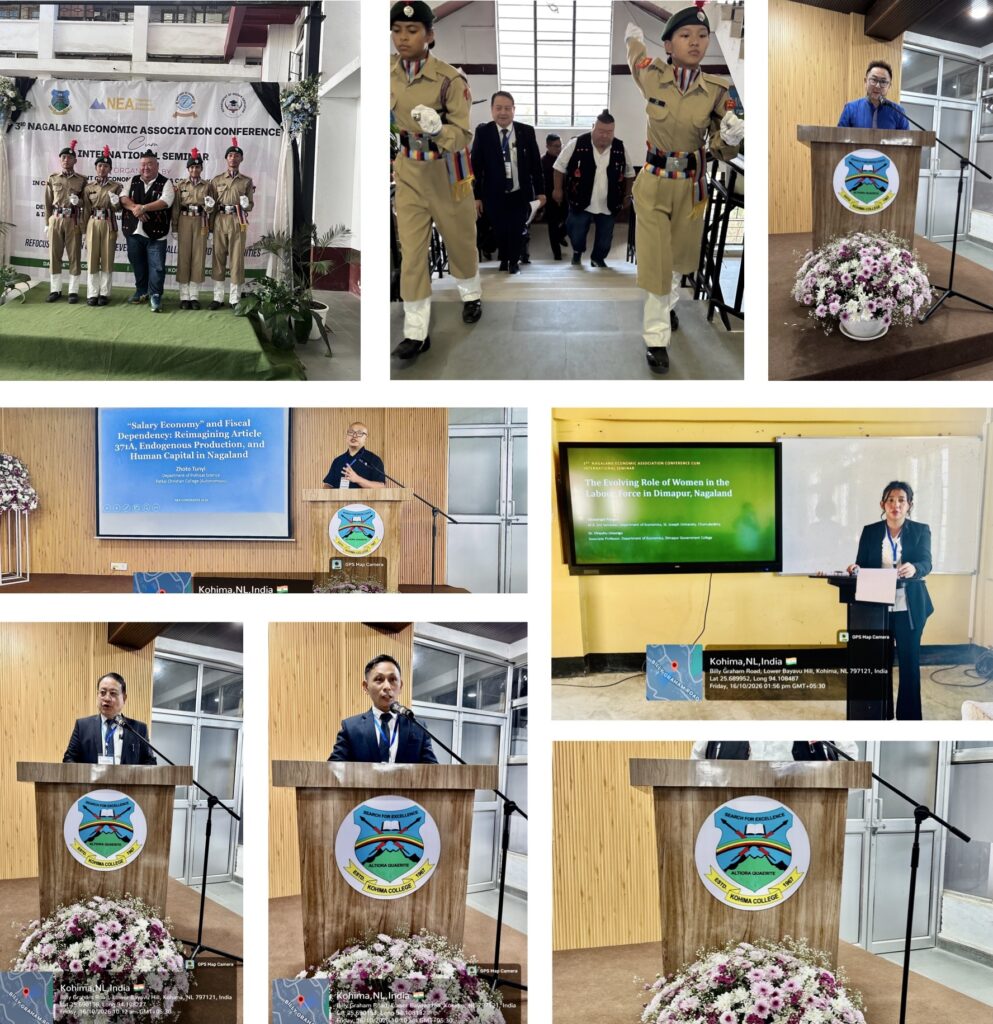
Oct. 16, 2026: The 3rd Nagaland Economic Association (NEA) Conference-cum-International Seminar was held at Kohima College, Kohima, bringing together academicians, researchers & students to deliberate on human capital development & the economic challenges and opportunities facing Nagaland.
Organised by the Department of Economics, Kohima College, in collaboration with the Nagaland Economic Association (NEA) & supported by Department of Higher Education, GoN, & Internal Quality Assurance Cell (IQAC), Kohima College, the seminar was themed “Refocusing Human Capital Development: Challenges and Opportunities”.
Chairing the inaugural session was Dr. Medongulie Zatsu with NEA President & Kohima College Principal, Dr. Vitsosie Vupru delivering the welcome address.
The programme also saw special performances by former & current students J Lhousa, N Vikhrie & Atsolü.
The keynote speaker Prof. Zuchamo Yanthan, Discipline of Library & Information Science, School of Social Sciences, IGNOU, New Delhi, adopted a question-driven approach to critically examine some of Nagaland’s most pressing developmental challenges & explore ways to transform the state’s human resources into meaningful opportunities.
Beginning with the question, “What is Nagaland’s greatest resource?”, Prof. Yanthan asserted that the state’s greatest resource lies not beneath its soil but within its people. He emphasised that the Naga people themselves constitute the state’s human capital &, when equipped with the right skills & opportunities, can become the driving force of development. He described the challenge as one of transforming “human capital into human possibilities” & “job seekers into opportunity creators”. He further stressed that the people are not merely resources to be utilised for development but the very creators of development. Accordingly, he urged participants to shift their focus from asking where jobs could be found to asking where opportunities existed & how they could be created.
On the relevance of education, he questioned whether Nagaland’s curriculum adequately addressed real-world needs & whether it produced merely degree holders or capable problem-solvers. He underscored the need for an education system that cultivates practical skills, innovation & the ability to respond to societal challenges.
Addressing entrepreneurship, Prof. Yanthan called for a broader understanding of the concept beyond conventional business activities. He explained that entrepreneurship involves recognising opportunities, creating value & translating ideas into action. Every academic discipline, he noted, offers possibilities for innovation & value creation when connected to real-world needs.
On the question of converting Nagaland’s strengths into opportunities, he advocated moving beyond the production of raw materials towards value addition through processing, packaging & branding. He also highlighted the potential of tourism & homestays to generate livelihoods, stressing that these initiatives must create meaningful opportunities for local communities. That Nagaland must build its capacity to compete while drawing on its unique strengths & resources.
Prof. Yanthan also examined the potential of migration, asking how it could be transformed into a source of strength. He advocated a shift from the “migration of talent” to the “circulation of talent”, encouraging approaches that enable people to share their skills, experiences & knowledge with their home state.
On governance, he urged the government to function as an enabler rather than the sole provider of opportunities. He emphasised that its responsibility should be to create an environment in which people can succeed through improved accessibility, research support, mentorship, incubation centres etc & for young people to be able to access these opportunities.
Highlighting the centrality of women in development, he opined that no meaningful progress was possible without placing women at its centre. He stated that women were already custodians of traditional knowledge, farmers, workers, vegetable vendors etc, but face multiple bulwarks limiting their potential. To quote Prof. Yanthan, “Empowering women strengthens families, communities & ultimately, the economy”.
Concluding his question-driven reflection, Prof. Yanthan called for a redefinition of success, a broader one that recognises innovation, entrepreneurship, problem-solving & the creation of opportunities as equally important pathways to individual & collective progress.
This impactful speech was followed by Shri Temjen Imna Along’s oration, Minister of Higher Education & Tourism, Government of Nagaland (GoN), who attended as the Special Guest. The Minister stated that while the potential for Nagaland state is immense, the state is facing a huge “Human Resource Quality Crisis”. He stressed the need to inculcate resilient character with inclusivity. That Nagas need to be sustainable from within.
The inaugural session was followed by two parallel academic sessions featuring research presentations on a wide range of issues relating to human capital, employment, education, technology, fiscal dependency & sustainable development in Nagaland.
Among the papers presented were “Beyond Employability: Education, Labour Market Constraints & Socioeconomic Insecurity in Nagaland” by Renthungo Odyuo; “Indian Tax Reforms & GST Awareness” by K Mariziio Choro & Dr. Yelhi Vero; & “Youth Labour Market Outcomes in Nagaland: Gender & Rural-Urban Gaps in 2025” by Dr. Saju Mathew & Dr. Mohd Faishal. Others examined the relationship between Article 371A, indigenous production & human capital; occupational exposure to generative AI in Nagaland; household poverty & income inequality in urban Kohima; & inter-district disparities in education in the state.
The sessions also addressed employment & unemployment in Nagaland, consumer awareness in Chümoukedima & Dimapur, labour migration to Kohima district, consumer behaviour towards online food ordering & delivery platforms, expenditure behaviour among college students, the evolving role of women in the labour force, & the prospects & constraints of sustainable ecotourism in Phek district.
The valedictory session was led by Dr. Evothung Ezung, Associate Professor, Department of Economics, Kohima College. Dr. Kekhrielhoulie Yhome, Adviser for School Education, Government of Nagaland (GoN), attended as the valedictory guest and delivered an address. Associate Professor Lily Angami, HoD of the Department of Economics, Kohima College, presented the final remarks. The programme concluded with the NEA Business Hour.
This academic platform brought together academicians, researchers, statesmen & students to deliberate on human capital development and the economic challenges and opportunities facing Nagaland. Doing so provided opportunities for introspection on the links between education, employment opportunities, socioeconomic insecurity and regional development.