
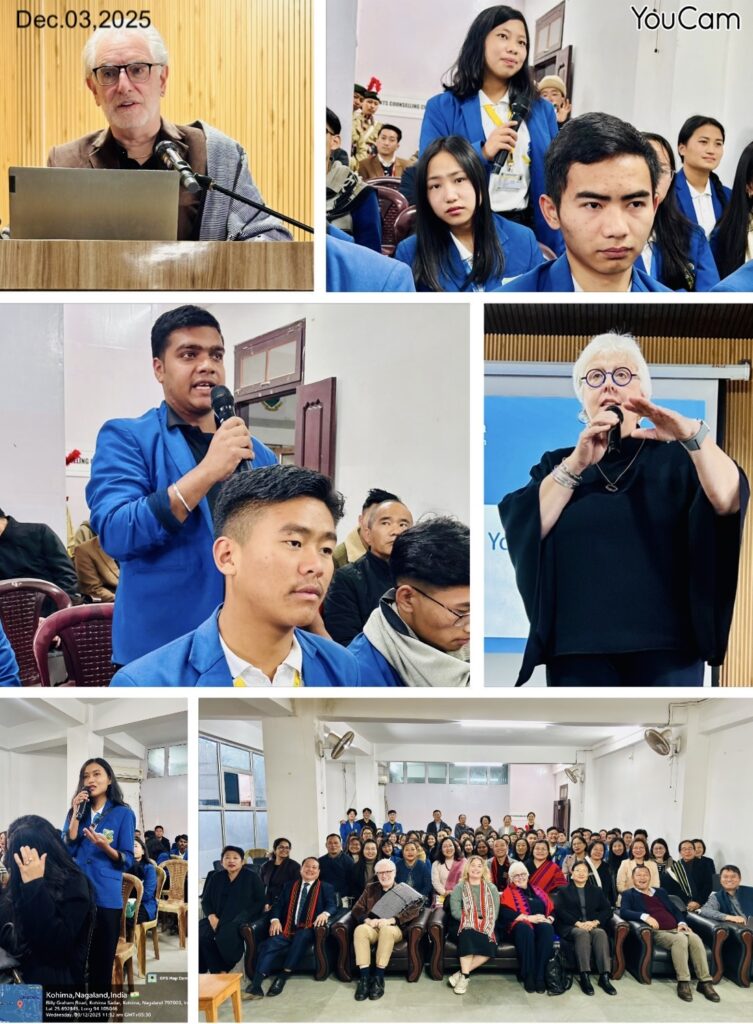
Dec 3, 2025: Kohima College, Kohima, in collaboration with the Embassy of Ireland in India, hosted a landmark international public lecture titled “Ireland and the Empire”, transforming the college campus into a hub of historical inquiry, diplomacy, and cultural dialogue. The event, held as part of Ireland’s participation in the Hornbill Festival 2025, featured Professor Jane Ohlmeyer, one of Ireland’s most influential historians, and His Excellency Kevin Kelly, Ambassador of Ireland to India, Bangladesh, Nepal, Sri Lanka and the Maldives.
Principal Dr. Vitsosie Vupru described the occasion as “a red-letter day”—the first time Kohima College has collaborated directly with a foreign nation. He highlighted the college’s growth from modest beginnings as a night college in 1969 to a thriving institution offering ten undergraduate departments and two postgraduate programmes, with a current enrolment of 1,908—the highest among Nagaland’s government colleges.
He also announced a forthcoming reading workshop on James Joyce’s Dubliners, facilitated by Kaivalya Plays from New Delhi, organised jointly with the Embassy of Ireland.
Before the formal session, the Irish delegation engaged in a warm and lively interaction with the faculty. Ambassador Kelly was presented with an Angami traditional shawl, and Professor Ohlmeyer with a Chang women’s shawl, both of which they received with enthusiasm. Ohlmeyer remarked on her joy at finally visiting Nagaland, calling the state “a beautiful, beautiful place”.
Ambassador Kelly presented the college with a specially crafted Irish–Indian keepsake box, richly decorated with Celtic and literary symbols—among them the shamrock associated with St. Patrick and motifs reflecting Irish mythology and architecture. Inside the box were engraved brass plates bearing quotations from Irish literature. Professor Ohlmeyer gifted the college a signed copy of her book, Making Empire: Ireland, Imperialism, and the Early Modern World.
In his keynote remarks, Ambassador Kevin Kelly framed Ireland’s presence at Hornbill as part of a multi-layered engagement with Nagaland. Ireland’s cultural delegation includes the Irish band Bóinn, a theatre collaboration connected to the upcoming Joyce workshop, and “Danu”, a 16-foot Celtic goddess statue created by artists from Kolkata and Galway.
Kelly spoke candidly and movingly about Ireland’s own long struggle with colonialism, violence and partition, drawing striking parallels with the historical experiences of Northeast India. Recalling his childhood in Northern Ireland during the height of sectarian conflict, he described neighbourhoods divided by identity, daily threats of bombings, and communities torn apart by competing nationalisms. The 1998 Good Friday Agreement, he explained, transformed this reality—not by erasing political differences, but by creating a framework for peaceful coexistence and dual identities.
“The peace agreement is not perfect,” he said, “but it remains one of the world’s most successful examples of negotiated peace.”
Kelly highlighted the relevance of this experience to Nagaland, praising Naga civil society and leaders for their commitment to peaceful dialogue and unity across tribal and national borders. He noted that Ireland, too, grapples with the ongoing legacies of partition and complicated relations with the United Kingdom, especially in the post-Brexit era.
With characteristic warmth and humour, Kelly ended his speech by offering a greeting in Irish, before thanking the audience for what he described as “one of the warmest welcomes I have ever received.”
Moderator Dr. Eunice Alinger, Associate Professor of History, introduced Professor Ohlmeyer, detailing her prolific academic career—13 books, more than €22 million in research grants, leadership roles at Trinity College Dublin, and her pioneering work on the 1641 Depositions. Calling her one of the foremost scholars on Ireland and Empire, Dr. Alinger emphasised her ability to make complex histories accessible to global audiences.
Professor Ohlmeyer delivered an engaging and incisive lecture that mapped Ireland’s long, troubled, and often contradictory relationship with empire. Speaking without notes, she traced Ireland’s role across four interconnected historical arcs:
1. Ireland as England’s first colony
Ohlmeyer explained how colonisation of Ireland from the 12th to 17th centuries involved not only military conquest but cultural transformation—imposing English language, religion, legal systems and economic structures. She compared these processes to later British policies in India, noting that many imperial strategies were first tested in Ireland.
2. Ireland as a “laboratory of empire”
She discussed early racial hierarchies articulated by figures like Gerald of Wales and Edmund Spenser, whose depictions of the Irish as “barbarous” or “uncivilised” laid foundations for later imperial ideologies. Similar language would later be used to demean colonised peoples elsewhere, including in India.
3. Irish participation in making empire
Many Irishmen—both Protestant and Catholic—served as administrators, soldiers, surveyors and civil servants across the British Empire. She highlighted Gerald Aungier, an early governor of Bombay, and the disproportionately Irish presence in the British Army in India by the 19th century. Even ordinary Irish soldiers and women left their traces in graveyards from Delhi to Mumbai.
4. Irish contributions to unmaking empire
Irish nationalists deeply influenced Indian freedom fighters. Figures such as Charles Stewart Parnell, Michael Davitt, Dadabhai Naoroji, Annie Besant, Maud Gonne, and Rabindranath Tagore formed vibrant intellectual circuits. The Easter Rising of 1916 inspired the Chittagong uprising, and Irish hunger-strike tactics were mirrored in India.
Ohlmeyer concluded with reflections on memory, amnesia and responsibility. She noted that while Ireland often views itself purely as a victim of empire, Irish individuals also participated in colonial violence—including key roles in events like the Jallianwala Bagh massacre.
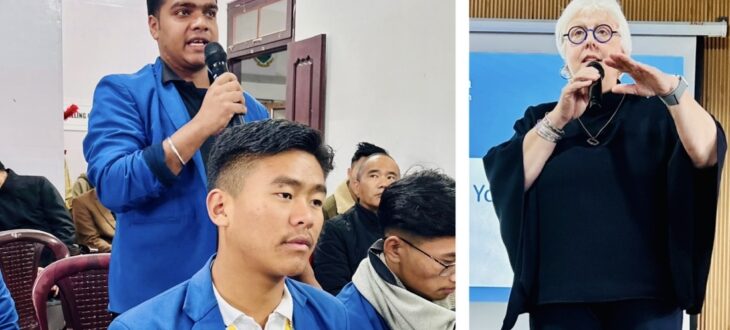
The Q&A saw students raise probing questions about colonial trauma, peace-building, racial violence and brain drain. Ambassador Kelly addressed recent racist attacks on Indians in Ireland, acknowledging them as “horrific” but emphasising that Ireland strongly values its Indian community and has taken decisive measures to protect them. Ohlmeyer added that scholars speaking against racism often face online harassment, but must persist in shaping inclusive narratives.
In her closing remarks, Dr. Alinger emphasised that Irish and Indian histories are “entangled rather than isolated.” Professor Ohlmeyer expressed hope that this event marks the beginning of long-term partnerships in research, education and culture.
The programme concluded with a photo session and a luncheon for the delegates.
For Kohima College, the day stood as a milestone—one that opened a meaningful bridge between Nagaland and Ireland, built on shared histories, honest conversations, and the promise of future collaboration.