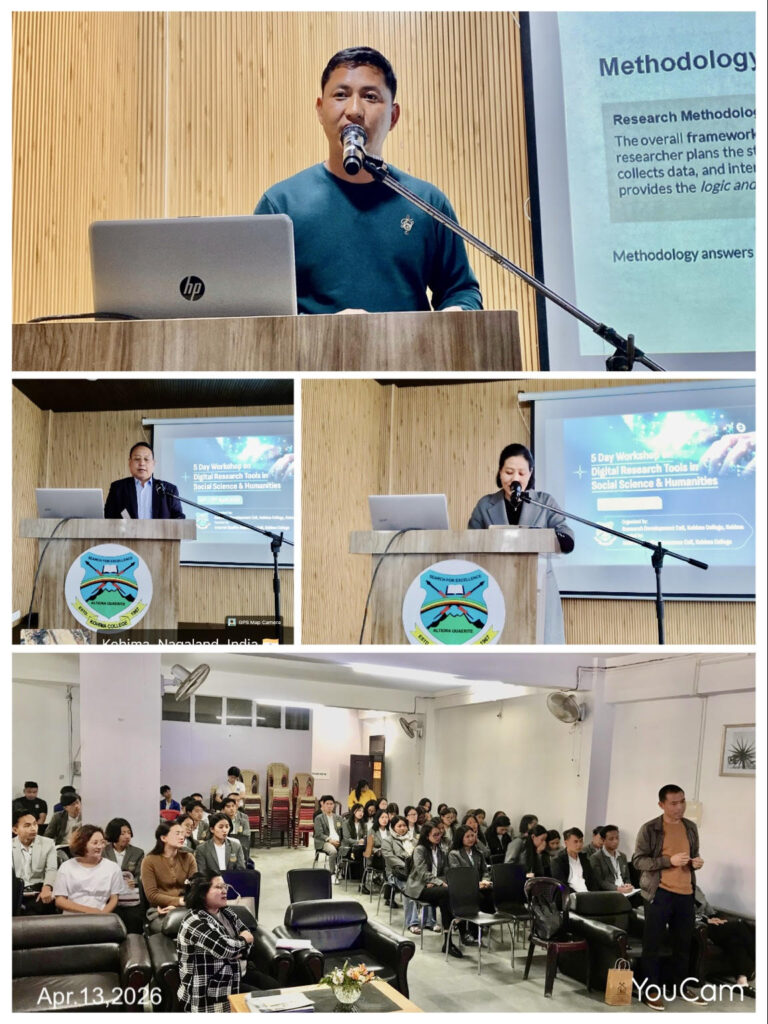
The five-day workshop on “Digital Research Tools in Social Science & Humanities,” organised by the Research Development Cell (RDC), Kohima College, commenced today with a strong focus on building foundational research skills among participants.
Funded by the Internal Quality Assurance Cell (IQAC), the workshop brings together faculty, scholars, and students to engage with key aspects of contemporary research, including methodology, academic writing, data analysis, and the ethical use of digital tools.
The inaugural session, was chaired by Dr. Konei Nakhro. Dr. Vitsosie Vupru, Principal, Kohima College Kohima, formally declared the programme open and encouraged participants to develop rigorous and meaningful research practices.
The academic sessions for the day were led by Shri Khrieneikuo Zumu, who delivered two detailed presentations aimed at strengthening participants’ conceptual clarity. In the first session on Introduction to Research Methodology and Types of Research, he described research as a systematic and scientific process of understanding social reality. He highlighted the distinction between research methodology and methods, and explained various classifications of research based on purpose, objectives, approach, and time dimension. He emphasized that research in the social sciences is inherently flexible, often combining multiple approaches to produce comprehensive and reliable knowledge.
In the second session on Research Approaches and Design, Shri Zumu focused on one of the most critical stages of research- choosing an appropriate approach. He outlined the key approaches of quantitative, qualitative, and mixed methods, linking them to broader philosophical orientations such as positivism and interpretivism. He further explained research design as a strategic blueprint that guides the entire research process, from identifying a problem to analyzing data and presenting findings. Practical insights were also shared on framing research problems, formulating hypotheses, and ensuring coherence in methodology.
Both sessions concluded with an engaging question and answer session involving students and faculty.
Over the course of the workshop, participants will engage in a wide range of topics such as literature review, referencing and plagiarism, research proposal writing, and fieldwork techniques. Sessions will also include hands-on training in statistical tools like SPSS, document preparation using LaTeX, and reference management software such as Zotero and Mendeley.
The final day will highlight emerging concerns in academia with a session on the ethical adoption of artificial intelligence in research, followed by training in academic writing and publication. The workshop will conclude with a valedictory programme, including a rapporteur’s report, certificate distribution, and a vote of thanks.
Organisers expressed hope that the workshop will strengthen research capabilities among participants and foster a culture of academic excellence within the institution.